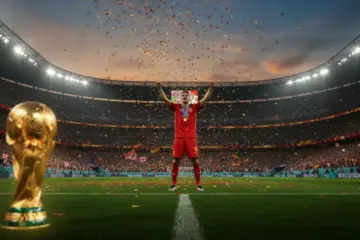
Senegal enters the 2026 World Cup with real ambition, not the polite kind that is usually reserved for outsiders. Head coach Pape Thiaw captured that shift clearly when he said that if he ever doubted Senegal could win the tournament, he would walk away from the job.
That kind of statement might once have sounded unrealistic, but Senegal has earned the right to speak that boldly. The team has become one of Africa’s most reliable powerhouses, blending experienced leaders with a steady stream of top-level prospects. For fans and bettors who study long-shot value, the Senegal World Cup 2026 outlook is no longer a novelty story. Canadian bettors can also back Senegal for the World Cup on Rexbet Canada, where the appeal lies in a squad that mixes proven stars with younger talent ready for the global stage.

Still, Senegal’s rise has a second side that is harder to celebrate. The same system that keeps producing international-quality players also leaves deep strain on the local game. Success at the top has often depended on structures that are efficient for Europe, but far less generous to the clubs and communities that first developed the talent.
How the Talent Pipeline Works
Senegal’s football output is remarkable for a country of about 20 million people. It regularly produces elite players at a rate that outpaces some African countries with far larger populations. Much of that success comes from academies such as Generation Foot, Diambars, and Dakar Sacre Coeur, which provide coaching, schooling, and medical support before sending players into the European market.
The model is polished, but it is also uneven. Many of these academies are tied to long-term deals with European clubs, which means the wealth generated by the player pipeline is often captured far from the places where the players were developed. FC Metz’s relationship with Generation Foot is a clear example: the partnership has lasted more than two decades and helped produce names such as Sadio Mane, Ismaila Sarr, and Pape Matar Sarr.
The problem is the return to Senegal. In one recent review of 13 academy-trained players who reached Senegal’s continental squads, their local academies received only €100,000 in initial transfer fees, while European clubs later sold the same players for a combined €81.2 million. Across their careers, those 13 players have generated more than €411 million in total transfer fees. The numbers make the imbalance easy to see.
Local football therefore lives with a contradiction: the country keeps producing talent, but the domestic game often receives too little of the value that talent creates. Clubs struggle financially, stadiums need work, and the local league remains far less visible than the export market. Even compensation rules are not always handled smoothly, and clubs have at times had to fight just to recover the solidarity payments that FIFA regulations say they deserve, including in cases such as Nicolas Jackson’s €37 million transfer to Chelsea.
The Other Half of Senegal’s Advantage
Senegal’s progress is not built only on domestic academies. The federation has also become highly effective at recruiting dual-national players from the diaspora before they commit elsewhere. That approach has changed the country’s ceiling by giving Senegal access to talent that might once have chosen another flag.
In practical terms, the strategy is simple but disciplined. The federation identifies promising players in Western Europe between ages 16 and 19, then works to secure their commitment before another national team closes the door. Cultural identity matters, but so does the sporting reality of joining a side that now expects to compete deep into major tournaments. Recent examples include PSG forward Ibrahim Mbaye and Chelsea defender Mamadou Sarr, both of whom previously played for France at youth level.
One way to understand the balance is to compare the two sources of strength side by side:
| Source | What It Provides | Main Trade-Off |
|---|---|---|
| Local academies | Technical training, discipline, and a steady flow of elite prospects | Limited financial return to domestic clubs |
| Diaspora recruitment | Immediate access to high-level European development | Requires early, constant engagement and strong persuasion |
That combination has made Senegal more complete than it was a decade ago. It can now produce players at home and attract them from abroad, which gives the national team a rare depth of quality across multiple positions.
Why 2026 Matters So Much
The 2026 tournament may be the last true chance for Senegal’s most famous generation to make a final, defining statement. Sadio Mane, Kalidou Koulibaly, and Edouard Mendy have carried the team’s modern rise, and a World Cup in North America could be their last major stage together.
The squad profile is especially striking because of its age range. Veterans such as 36-year-old Idrissa Gana Gueye can share a lineup with teenagers who already play at elite club level. That mix gives Senegal both stability and fresh energy, which is one reason observers see them as more than a sentimental underdog.
According to the tournament path, Senegal faces a demanding Group I with France, Norway, and Iraq. The opening match against France in New Jersey is likely to reveal a great deal about their ceiling. If Senegal gets through the group, its organization, physical strength, and depth could make it a dangerous knockout-round opponent. The team has enough quality to chase something historic, even if the domestic system behind it still needs serious repair.
- Win the group-stage battles early enough to avoid pressure in the final matchday.
- Use midfield control and defensive discipline to limit stronger opponents.
- Rely on depth, not just star names, when the schedule tightens.
- Turn tournament momentum into the kind of belief that carries into knockout play.
That is the paradox of Senegal’s rise. The national team has become stronger than ever, but much of that strength has been built through a structure that still sends too much value outward and not enough back home.