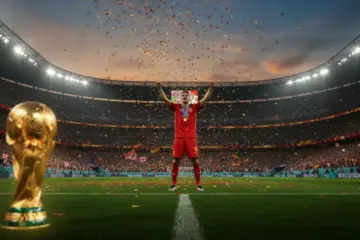
Portugal has unveiled a World Cup squad that blends star power, tactical flexibility, and a powerful emotional current. Cristiano Ronaldo is in the group and remains the central figure in the discussion, but this announcement also carried a tribute that gave the entire selection extra meaning. Roberto Martínez’s choices suggest a team that believes it can chase the trophy while carrying the memory of Diogo Jota with it every step of the way.
Ronaldo’s Pursuit of One More Milestone
At 41, Ronaldo is still the name that commands the spotlight whenever Portugal plays on the biggest stage. If he appears in this tournament, he will add another historic line to a career already filled with them: a sixth World Cup appearance, a mark reached by very few players in the men’s game. That possibility alone makes Portugal one of the most closely tracked teams in the competition.
Ronaldo’s place in the squad is not just ceremonial. Martínez continues to value his competitive edge, dressing-room presence, and ability to decide matches even when the game plan shifts around him. The forward’s longevity has become part of his legend, but so has his habit of delivering when expectations are highest.
His record book already includes some of the most significant achievements in international football. He stands as the leading scorer in men’s international play, the player with the most appearances, and the only male footballer to score in five separate World Cups. For Portugal, he is still the symbol of an era that transformed the national team’s ambitions.
A Squad Built for Balance and Flexibility
Portugal’s roster is notable for how many different ways it can be shaped. Martínez has selected players who can control possession, press aggressively, attack in wide spaces, and adapt to several formations without losing quality. That kind of variety gives the team a chance to respond to different opponents rather than forcing one style in every match.
The overall makeup of the squad is especially interesting because it mixes long-established leaders with younger players who bring speed, freshness, and technical confidence. The result is a group that can start matches with authority and also change tempo from the bench.
| Unit | Key Strength | Notable Names |
|---|---|---|
| Goalkeepers | Security and reliability | Diogo Costa, José Sá, Rui Silva, Ricardo Velho |
| Defenders | Leadership and fullback quality | Rúben Dias, João Cancelo, Diogo Dalot, Nuno Mendes |
| Midfielders | Creativity and control | Bruno Fernandes, Bernardo Silva, Vitinha, João Neves |
| Forwards | Finishing and pace | Cristiano Ronaldo, Rafael Leão, João Félix, Gonçalo Ramos |
Where the Squad Looks Strongest
Portugal’s back line looks capable of handling almost any challenge. Rúben Dias provides the organizing voice, while players such as João Cancelo, Diogo Dalot, and Nuno Mendes add a forward-driving threat that can turn defense into attack in a matter of seconds. That ability to stretch the field from deep areas is one of the team’s most important weapons.
In midfield, Bruno Fernandes and Bernardo Silva remain the clearest creative engines. Both can unlock packed defenses, control the rhythm of possession, and connect the team’s structure to its attackers. Vitinha and João Neves bring a different kind of value, offering energy, composure, and quick circulation that can keep Portugal moving even under pressure.
The attacking group may be the most exciting part of all. Ronaldo gives Portugal a proven scorer in the middle, but the team also has direct runners and one-on-one threats. Rafael Leão can change a match with acceleration, Pedro Neto adds relentless width, and Gonçalo Ramos offers a classic central striker option. That variety matters in a tournament where a team often needs more than one plan to survive.
Diogo Jota’s Memory Shapes the Tournament Mood
For all the quality in the squad, the emotional core of the announcement belonged to Diogo Jota. The former Liverpool and Portugal forward died in a car crash in Spain last year at the age of 28, a loss that left teammates, supporters, and the wider football world deeply shaken. Martínez made clear that Jota’s influence is still present inside the camp.
Although World Cup squads are limited to 26 players, Portugal listed 27 names symbolically and described Jota as the team’s everlasting “plus one.” That gesture speaks to more than remembrance. It reflects a belief that his spirit and example should remain part of the squad’s identity throughout the tournament.
In practical terms, that tribute may also serve as motivation. Teams often search for a source of unity during major tournaments, and Portugal now has one that is both personal and powerful. Jota’s memory gives the group a reason to keep perspective when the pressure rises.
Portugal’s Opening Path and Preparation Plan
Portugal has been placed in Group K, where it will meet Congo, Uzbekistan, and Colombia. The opening match against Congo is scheduled for June 17 in Houston, and the build-up begins much earlier as the team gathers on June 1 to prepare. Those early days will matter, because the squad needs time to settle roles and sharpen combinations before the competition begins in earnest.
The warm-up schedule includes a June 6 match against Chile and a June 10 meeting with Nigeria, followed by travel to the United States on June 12. These games should provide Martínez with a useful look at his preferred patterns and his backup options. The staff will likely use them to test how the team functions with different attacking references and defensive shapes.
- Gather the full squad and establish the base tactical plan.
- Use the Chile and Nigeria matches to evaluate rhythm, pressing, and finishing.
- Confirm the starting core and late-game substitution patterns.
- Arrive in Houston ready for the opening match against Congo.
Can Portugal Actually Win It All?
Martínez has been careful not to hand Portugal the label of favorite, and that restraint makes sense. He has suggested that the title belongs more naturally to teams that have already won the World Cup, while Portugal still remains in pursuit of that first crown. Even so, the squad’s recent form gives supporters real confidence.
The biggest evidence came in the 2025 Nations League, when Portugal beat Germany in the semifinal and Spain in the final. Those results showed that the team can handle elite opponents in tight, high-stakes moments. That experience matters in a World Cup, where one strong performance can reshape the entire bracket.
Portugal also benefits from a rare combination of qualities: high-level experience, tactical options, and emotional purpose. If the team stays healthy and Martínez finds the right balance between caution and ambition, there is every reason to think Portugal can remain in the conversation deep into the tournament.
What Makes This Team Dangerous
Portugal’s challenge is not talent. It is turning that talent into a coherent knockout-stage identity. The good news is that the squad has multiple ingredients that usually separate contenders from also-rans. Ronaldo brings belief. Fernandes and Silva provide invention. Dias stabilizes the back line. Leão and Neto can break open matches. Jota’s memory adds an emotional edge that may be hard for other teams to match.
That combination could make Portugal one of the most complete sides in the field. The ceiling is obvious, but the floor is also high, because the squad has enough depth to survive injuries, tactical changes, and the natural unpredictability of tournament football.
For now, the story is straightforward: Ronaldo is chasing another historic milestone, Martínez is chasing Portugal’s first World Cup title, and the entire squad is carrying Diogo Jota’s memory as a source of strength. It is a powerful starting point for a campaign that could become unforgettable.