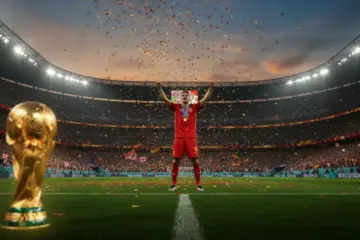
Every World Cup tells a few stories at the same time. The story of who wins. The story of who almost wins. The story of the player who arrives late and leaves early. The story of the team that nobody expected to see in the quarter-finals. The story of the country that does not show up at all. By the time the trophy is lifted at MetLife Stadium on July 19, 2026, the tournament will have produced its own version of each of these, and most of them will not be the versions anyone is currently predicting.
What follows is a guide to the storylines that are already visible. The ones being written about now, the ones being talked about in pubs and offices and on radio shows, the ones that the football media will return to once the matches start producing their own evidence. None of these will tell you who lifts the trophy. All of them will tell you something about the tournament you are about to spend thirty-nine days following.
Messi’s Final Tournament
Lionel Messi has confirmed that the 2026 World Cup will be his last. He will be thirty-eight when the tournament begins, the same age Diego Maradona was when he played his final cap, and the storyline of his goodbye lap is already shaping how Argentina’s group is being read, how their fixtures are being scheduled, and how the global television audience is being primed to follow the tournament.
Argentina arrive as defending champions, drawn into Group J alongside Algeria, Austria, and Jordan, with a path through the group that on paper is among the more forgiving of any top seed. The interesting question is not whether Messi will play. The interesting question is what shape Argentina takes around him, given that the supporting cast that won the trophy in Qatar has been quietly evolving in the years since. The 2026 squad is not the 2022 squad, even if the headline name is the same.
Whether the tournament produces a fairytale ending, a quarter-final exit, or something in between, this is the last time the most prolific player of his generation will be on a World Cup team sheet. That alone makes Argentina’s run worth following from the opening match to whatever match eventually ends it.
The Country That Did Not Make It
Italy will not be at the 2026 World Cup. The four-time world champions were eliminated by Bosnia and Herzegovina on penalties in the European playoff final on March 31, missing their third consecutive tournament. It is the longest absence in Italian footballing history at senior level, and it shapes the European section of the bracket in a way that is more profound than the simple removal of one team.
For most of the past century, Italy at a World Cup was a structural certainty. The Azzurri were either a contender, a tactical reference point, or a benchmark for European footballing identity, and the tournament’s competitive landscape was calibrated around their presence. Their absence from 2026 reshapes that landscape. Bosnia and Herzegovina inherits the qualifying spot and arrives carrying the most dramatic backstory of any European entrant. Other European sides find their predicted paths through the bracket softer than they would have been with Italy in the field.
The Italian relationship to the tournament has shifted from participatory to spectatorial, and the editorial weight of that absence will sit over the group stage and beyond. For Italy, 2030 is now the project, and the post-mortem of how the country’s football came to miss three consecutive World Cups will be one of the longer subplots of the 2026 cycle.
The First-Time Qualifiers
Four nations are appearing at their first ever World Cup. Cape Verde topped their African qualifying group ahead of Cameroon. Curaçao, with a population of roughly one hundred and fifty-six thousand, became the smallest country by population to ever qualify. Jordan came through a forty-seven-nation Asian qualifying process, as did Uzbekistan, the first Central Asian nation to ever appear at a World Cup.
Each of these four arrives with a specific story. Cape Verde is a footballing nation built on a diaspora of players who hold Portuguese, Dutch, and French youth-system credentials, returning to wear the green and white at senior level. Curaçao’s qualification represents a Caribbean footballing renaissance that has been quietly building for the past decade. Jordan’s group draw alongside reigning champions Argentina makes their tournament debut a baptism of unusual difficulty. Uzbekistan’s emergence has been one of the more consistent footballing trajectories of the past five years, and their squad arrives at the tournament with several players already established at top European clubs.
The romance of a first-time qualifier is one of the World Cup’s quieter traditions. Some of these sides will be eliminated quickly. At least one will probably write a story that nobody currently expects.
The Format That Changes Everything
The 2026 World Cup is the first to use the forty-eight team format. That detail will be repeated in every preview written between now and June, but the actual implications of the format change are still being worked out, and the tournament itself will be the first laboratory in which the new mathematics is tested under competitive conditions.
Twelve groups of four. Top two from each group plus the eight best third-placed sides advancing to a new round of thirty-two. From there, the familiar bracket of round of sixteen, quarter-finals, semifinals, and final. A team that wins the trophy will play eight matches across thirty-nine days, the most ever required of a World Cup champion. The bracket has been engineered to keep the four highest-ranked teams in opposite halves until the semifinals, a structural decision that protects marquee matchups for the late rounds.
What the format produces in practice will define the next several World Cup cycles. The 2026 edition will form the evidence base for how the format is adjusted, defended, or quietly redesigned for 2030 and beyond. Reading the tournament carefully, in that sense, is reading the first draft of a new tournament era.
The Hosts and What They Want From This
Three host nations, three distinct competitive ambitions. The United States, drawn into Group D with Paraguay, Australia, and Türkiye, opens at SoFi Stadium against Paraguay on June 12. The American program has matured noticeably since the 2022 cycle, and the home advantage in front of an American crowd is the kind of variable that can lift a side beyond its rankings.
Mexico opens the tournament at Estadio Azteca against South Africa, a deliberate echo of the 2010 opener. The Mexican program has spent the past four years preparing for a tournament in which the host advantage at Azteca, Guadalajara, and Monterrey is expected to translate into a deeper run than recent World Cup cycles have produced.
Canada’s group draw is the most demanding of the three host nations. Drawn into Group B alongside Bosnia and Herzegovina, Qatar, and Switzerland, the Canadian path through the group depends heavily on the opening match in Toronto. Whatever the result, Canada hosting a senior men’s World Cup match for the first time in the country’s history is a moment with weight beyond any single fixture’s outcome.
The Trophy and Who Lifts It
The trophy will be lifted on the evening of July 19 at MetLife Stadium. Whose hands lift it is the central question the tournament asks, and the answer will be the result of a path through more football than any World Cup champion has previously been required to navigate.
France, Spain, Argentina, England, and Brazil arrive as the headline contenders. The bracket structure protects each of them from meeting until the semifinals, meaning the most likely final pairings come from opposite sides of the draw. Below those five, Germany, Portugal, the Netherlands, and Belgium each carry credible round-of-eight cases, with the occasional pocket of value in sides whose draw or path is more favourable than their generic outright odds suggest.
What history tells us about World Cup finals is that the favourite wins roughly half the time. The other half is split between second-tier contenders and the occasional outright surprise. Whatever happens between June 11 and July 19, it will not be predictable in the way preview pieces suggest, and the storylines that end up mattering are rarely the ones that look most prominent at the start of the tournament.
The fixture calendar above tracks every match across the thirty-nine days, updating automatically as the tournament progresses. Whether you are following a specific storyline or trying to follow the whole tournament, the schedule below is the simplest way to keep track of how each chapter unfolds.